|
| ||||||||||||||||||||||||||||||||||||||||||||||||||||||||||||||||||||||||||||
|
| ||||||||||||||||||||||||||||||||||||||||||||||||||||||||||||||||||||||||||||
 history of Recordings and recording—Page 4
the advent of Still photography
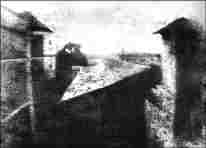
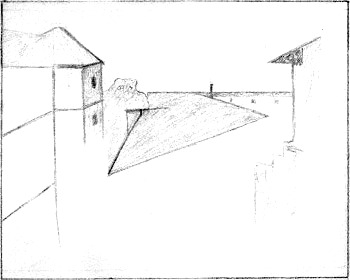
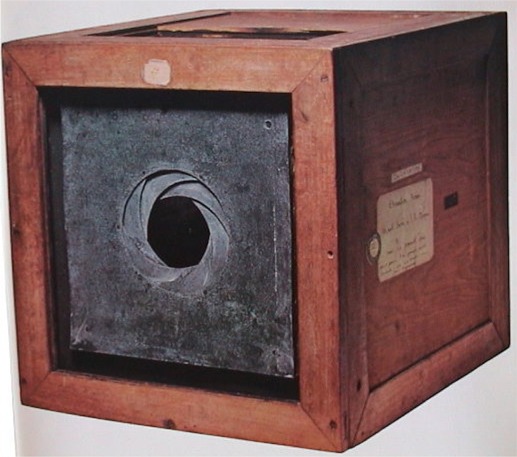
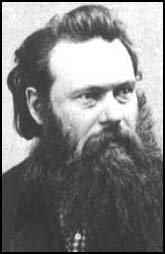
Niépce, the Frenchman who invented photography, is shown below at the right. His first photograph is shown below him, on the left. The technology Niépce developed is crude, but that's to be expected given the early state of the chemistry, science, and engineering that were available to him at that time. Niépce took the first photograph in the world by reaching out of his workroom window with his camera. In it, one can just make out a few buildings with a tree in the distance. For comparison, a sketch of the same scene drawn in 1952 is shown next to his camera photo, just to its right. The photo and sketch are remarkably similar and there is even more detail in the photo than in the sketch. Not bad for an exposure made in 1827! That's the camera he used to take the picture directly below the photo and sketch.
As if the world's first photograph wasn't enough, with his brother Claude, Niépce also conceived, created, developed, and built the first internal combustion engine, which he used to power a boat up the Saône river. In 1807 he received a patent for his invention from Napolean Bonaparte. Starting in 1829, Niépce began collaborating to improve photographic processes with Louis Daguerre. Together they developed physautotype. The partnership lasted until Niépce’s death in 1833. Daguerre continued with his experimentation, eventually developing a process he named after himself called Daguerréotype.
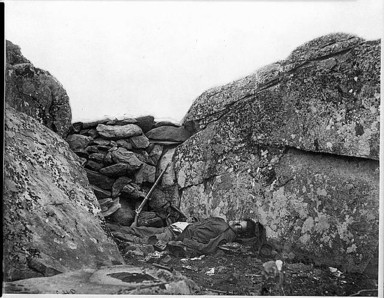
Progress was slow but steady. It wasn't until the start of the American Civil War in the early 1860s, thirty years after the invention of photography, that Mathew Brady first began to display and sell his employee's daguerreotypes of the war's carnage in his New York photography studio. These vivid pioneering photos, taken on both sides of battlefield principally by Scottish photographer Alexander Gardener, his brother, and his associates James Gibson and the brilliant Timothy O'Sullivan, revealed for the first time in history the reality, brutality, and destruction of war.
Notice how much better photography had become in those thirty years. There's far more detail, resolution, and clarity; there's more light and lighting is better balanced. The development of photography had a huge impact on society. The photos by Gardener and his associates who worked for Brady forever put an end to the previously romanticized notion that war could be glorious; they brought photography to the public's attention and changed its attitude toward military conflict; never again would citizens of the world be blinded to the true cost of war. They also established many of today's ethical conventions for news reporting. They virtually wrote the rules for what subjects to photograph; how to graphically compose, light, and dramatize subjects; and how to effectively convey information through the camera eye. Gardener also was Lincoln's favorite photographer, and his portraits of Lincoln both before and after the latter's assassination are the most famous and important ones we have. The Advent of motion pictures
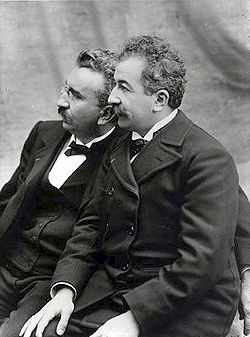
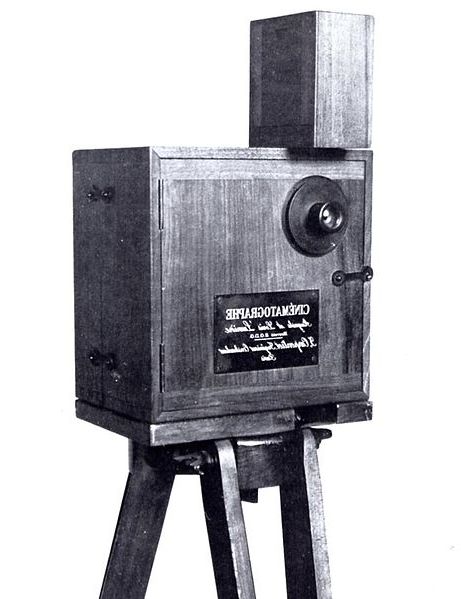
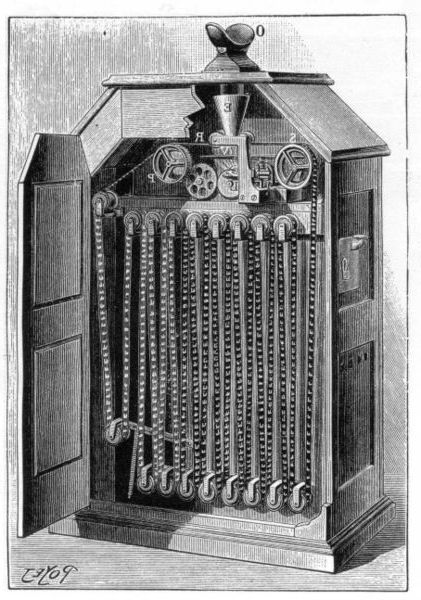
Most in the know people credit the invention of silent movies to the two French brothers, Louis and Auguste Lumière. Although a number of successful and partly-successful devices produced pictures that move prior to their monumental invention, there is consensus among experts that they were the first to devise a practical silent motion picture camera and projector, one that was portable, could expose and develop its own film on 35 mm film strips with sprockets, and could project clear and bright continuously moving pictures on a wall or screen large enough for an audience to see. That's a photograph of the Lumière brothers at the right and of their camera at the left, below. Their device, which was both a camera and a projector, they named the cinématographe. It and the films taken with it were publically exhibited for the first time in 1895. The Lumière brothers initially saw their device as a potential gold mine, and soon began producing films for audiences and charging audiences for admission. But they withdrew from the filmmaking business in 1905 because of competition from other, more commercially-oriented motion picture producers. They continued to participate in the film industry in a major way, but not as filmmakers; for example, they experimented with a color film of their own invention and became major providers of film chemicals and other movie products throughout Europe. Despite the significant Lumière contributions to the film industry, over the years some historians have disagreed intensely over who should get credit for inventing the first practical motion picture system. In part the intensity of this controversy stems from the honor associated with the creation of so important an art form and industry; and in part it stems from disagreements over the definition of practical and the ambiguity that arises over establishing an invention's date. As a result of factors like these, some American experts contend that Thomas Edison was the first to produce a practical motion picture camera and projector. The Edison Company was the first to a create a device that could display moving pictures that a single person could view using a film playback device. The invention, which he called the kinetoscope, was publically premiered in 1891, four years before the cinématographe. The kinetoscope was not personally invented by Edison as many believe, but he described his concept for it in 1888, about ten years after he'd filed his first patent for the electric light bulb. That's a photo of the kinetoscope at the right, below. The eyepiece at the top is about the height of a person's head when leaning over. The viewer bent forward, placing his head just above of the eyepiece, and manually turned a crank to advance the film past a lens. Later models incorporated electric drive motiors to advance a film. No doubt, the kinetoscope was a great step forward. It was not able to project moving pictures on a wall or screen for an audience to see, as was the cinématographe, but its invention preceded the cinématographeby ten years. And to its credit, it introduced the basic technique for mounting images on film strips that would become the standard for all commercial moving picture systems prior the advent of video. It created the illusion of continuous movement by using gears to transport a strip of 35mm film punctuated with sprocket holes past a light source. The film strip carried sequential images in frames, each of which was momentarily exposed to the eye by a high-speed shutter that was synchronized with the frames. Edison deployed his kinetoscope movies in New York city street parlors and at amusement parks and carnivals. At first they were very popular with the public and very profitable for moving picture operators because of their novelty. However, a machine like the kinetoscope that limited the display of a film to only one person at a time eventually proved to be a commercial liability because it couldn't display its film images on a large screen for audiences to see in a theater the way movie projectors could.
Media integrationA medium is a means of communication, such as radio, television, newspapers, still pictures, sound, still photographs, and moving pictures. By media integration, The Muse means the synergistic combination of two or more media by means of one or more technologies such as magnetic recording, electromagnetic transmission, or display projection. The product of a synergistic integration is often a new, different, and superior medium, a new technology, a new field of art, or a combination of these elements. Here are a few examples of media integration:
Media integration became an especially important phenomenon during the first quarter of the 20th century. Since then media integration has accelerated as a result of technological advances whose impact on society has unceasingly accelerated.
There have been too many media integration developments to survey them here; nor would a review of these 20th century developments be practical. Probably a single example is sufficient to clarify this concept. Here The Muse briefly explores the nature and social impact of media integration on the film industry and on film art during the first quarter of the 20th century. Undoubtedly you have personally experienced the results of media integrations like this one for yourself and can relate them to what happened with later 20th century integrations and with the many integrations that still are occurring. The earliest significant advance in media integration during this post turn of the century period was the addition to the silent film medium of the medium of sound. The advantages of adding sound to silents were recognized from the start by many developers in America, France, and elsewhere, and several abortive attempts to add sound to silent film took place before and soon after the turn of the century. Thomas Edison sought to capitalize on his invention of the phonograph when he introduced the kinetophone in 1895 in an attempt to augment his kinetoscope silent movie viewer with sound. It failed for a number of reasons, one of which was its inability to synchronize the sound emanating from the kinetophone, which was essentially a standalone phonograph, with the silent film motion seen through the Kinetoscope viewer. The brilliant French movie industry pioneer, Léon Gaumont, also experimented seriously with synchronizing silent film with sound. In 1902 he demonstrated his Chronophone system to the French Photographic Society using an electrical connection between film projector and turntable, and he went on perfecting his invention for years thereafter. Despite many technological difficulties, it wasn't until 1926 (or 1927, depending on how carefully you examine history) that moving pictures were successfully integrated and silent movies became talkies. It was exactly a century after Niépce's invention that sound and pictures were successfully merged into a single, practical, integrated medium. The crucial technical development was precise synchronization between two media: sound and moving pictures, a synchronization that could closely marry lip movement with speech, scenic action, and musical instruments. Numerous technical developments made this breakthrough possible. One of the key ones was a new technology called sound on film, whereby visual images representing sound could be recorded (photographically imprinted) onto a silent film next to the visual frame with which they were associated. Precise synchronization made lip synch possible because it placed sound on film, not sound with film, as it had with the kinetophone. Almost exactly a century after Niépce's invention of still photography (see above), sound and moving pictures were married into a single medium. The 1927 movie, the Jazz Singer, is widely accepted at the first commercially viable sound movie. Six fundamental advances in marrying sound with photography were necessary to make this movie practical: 1) still pictures, 2) moving images, 3) projection of moving images on a large screen, 4) sound recording, 5) electronic sound amplification, and 6) sound-on-film recording. Once these advances were in place together, sound could be combined with moving images and presented before a large audience. The merger of sound with film had could be accomplished in a way that could foster the movie industry, business, and the arts as never before. Seen from one point of view, this merger is perhaps the most momentous development in art history. Never before had it been possible to combine images and sound in such a way as to imitate life and to metaphorically transport large numbers of people to other worlds. After 1927, for example, movies had the power to immerse an audience in an overpowering multimedia experience. Could an artistic medium be more powerful than this?
the pace of change—the 19th, 20th, and 21st centuriesUntil relatively recently, improvements in recordings and recording have come slowly and laboriously. Writing began in the third millennium BCE but it was not until the advent of the Gutenberg press that mass distribution of the written word became practical. The four-hundred-odd-years that have ensued since the invention of Gutenberg's press in the 15th century have seen many refinements and improvements to printing technology but nothing else happened in the various fields of recording technology that was equally as revolutionary as the original circa 1439 invention until 1827, when French inventor Joseph Nicéphore Niépce made the first successful practical photograph. Soon after, practical sound recording was invented, in 1877. To the 21st century mind, photographic and sound recording may seem to have occurred in the far, far distant past because several generations have been born to them and take them for granted. No so, when measured by the time scale of Gutenberg's press. Even though photography began with Niépce and recorded sound with Edison, measured by the history of writing, recorded sound and photography are comparatively recent events, considering that mankind had written for over five thousand years and had played music for well over ten thousand years before it was able to record pictures or playback sound. Many people living today fail to realize that photography and sound reproduction go back as far as they actually do because, for practical purposes, they began only in the last half of the 20th century. It took decades of development after their invention before either of these technologies advanced to the point where it became practical enough to pass into common use. Sadly, only in the mid-to-late 20th century did many of these early pictorial and sound recordings become commercially available to mass media and the public, and many original recordings are still being unearthed. Because of these advances in sound and photographic recording technology, the 19th and 20th centuries proved to be a landmarks, milestones not only for recording technology but for the arts, as well. Progress in the arts advanced more rapidly because of these inventions. They opened the door to an explosion in the arts and led to the development of what was to become what is arguably the most important cultural advance in modern times—the sound movie. By contrast, a lot of water flowed over the proverbial dam during the time between the invention of writing in Sumer and Gutenberg's invention of printing. During these early years mankind made slow but significant progress in recording. More water flowed in the 400 years that passed between Gutenberg and the first photo and the first phonograph. After that, it took only about fifty years before sound and visual recording and playback became practical. Notice how the intervals between major recording advances get shorter as time passes. The 19th century marks the historical moment when intervals between recording advances began to shorten appreciably and advances in recording technology began to snowball. This pace continued to quicken in the first half of the 20th century and exploded in the last half. Edison's first phonograph was was a crude device that "wrote" sound on tin foil wrapped around a cylinder, but soon it developed into a modern miracle. The photograph, too, evolved quickly until now it is a boon to mankind. Today sound recordings and photographs carry information, inspire, entertain, educate, support research, and do a host of other jobs upon which modern society depends. The invention of sound recording and photography are significant in themselves because they mark the moment in history when mankind first became able to record sound or photographs. But they also are significant because they mark a sea change in mankind's ability to manage his artistic and creative environment by means of deliberate and focused technological innovation. Does this claim seem overreaching? When Sumerians conceived cuneiform writing and reading around 3,100 BCE, their advance was monumental. But before they could record their new language, they also had to invent a new scheme for writing on clay tablets with a wedge-shaped stylus, a scheme involving only two parts, one for each hand. Conceiving cuneiform wasn't simple or easy for them, nor was it a trivial accomplishment by any means. But the only technological challenge they had to meet before they could record their new language was to master the art of scratching symbols into soft clay tablets with a stylus, and then to dry them until hard, two technological feats not in the same league as those performed by Edison and Niépce when they invented sound recording and photography. The Sumerians already were using clay to plant food and bake dishware when they looked for a medium on which to record writing; by comparison, coming up with a way to inscribe symbols on clay and preserve them was technical child's play. Nor was the Sumerian technological accomplishment as great as the one performed by the Lumière Brothers and others when they developed motion pictures. Not only did Edison, Niépce, and the Lumières first have to conceive and imagine a vision for what they wanted to accomplish, as did the Sumerians; unlike the Sumerians, Edison, Niépce, and the Lumières had to do research; they had to gain insight into the fundamental workings of nature and then to deliberately increase their ability to manipulate fledgling new technologies. Finally, Edison, Niépce, and the Lumières had to deliberately set out to develop something new, complex, and radically different from almost anything accomplished previously, something with many parts that had to work together, and with parts that were disconnected from each other. They had to accumulate resources and assemble skilled cadres. Advancing recording technology has never been an easy process, but it has been necessary and vital. The lingering pace of technological advancement characterizing over the past centuries has cost society dearly. If Niépce had invented photography only fifty years earlier (at age 15, still in his lifetime) a French Mathew Brady might have been taking battlefield pictures of Napoleon and his Grand Army. Imagine how many lives might have been saved if military history had been changed for the better as a result! Beethoven died in 1827, just fifty years before Edison made his first recording. By all accounts, Beethoven was a masterful and innovative pianist whose private keyboard performances for small groups were legendary. Whether invited to play by his audience on the spur of the moment, or whether preplanned by him the night or week before, most of these impromptu performances were improvised in whole or at least in part. Some were premieres of new works still being composed or soon to be published; but others were tryouts for works in progress, passages played for close friends or mutual soiree-goers that never were never written down. What a shame that magnificent performances like these fell only on a handful of attentive ears but were then lost to the world outside. The loss is even worse than this. Unfortunately, many of Beethoven's studies and notes were never written down or were discarded after being scratched onto napkins, tablecloths, or paper scraps. Never recorded for posterity, he toyed with these musical ideas in his studio, played them only once, and then forgot or lost them. If sound recording had been invented only fifty years earlier, Beethoven's performances and other works that went unprinted or unpublished could have been captured on records. What a loss that they were not! And what about Mozart at the piano, Paganini at the violin, or Liszt in his prime, in the 1840s? What about Lord Byron reading his own works to an audience of friends? If only fifty years could have made so much of a difference with composers like these, just imagine all the other things, people, performances, and scenes that might be extant today, if sound or film recording had been invented 100 or 1,000 years earlier! Musical recordings and readings are only two examples. Only when we collectively consider all the recording media, their inventors, innovators, organizers, managers, enterprisers, and initiators who down through the centuries have bestowed on us the benefits of their genius, motivation, persistence, sacrifice, dedication, and willingness to risk all to help others do we begin to realize the full magnitude of the debt we own them. Happily, however, not all the great performers and performances have been lost to posterity. Thanks to the inventive spirit or people like Niépce, Edison, the Lumières, and thousands of others like them, incredibly a sizable residue of recorded musical and other performances have been captured, works dating as early as the turn of the 19th century. Musicians like Paderewski, Caruso, Sarasate, and Ysae can still be heard today. In many cases, these performances are brilliant, even unparalleled, despite the fact that the performers who made them were in the twilight of their years. How fortunate and fulfilling our lives have become because of the different recording media civilization has had access to; how blessed we are by the tens of thousands of discoverers, researchers, and inventors like Gutenberg, Niépce, Daguerre, Edison, and the Lumières. the 20th centuryMany 20th century recording technologies, media, and devices came and went during the first half of the century. Their names and abbreviations came and went too, names like wire recording, shellac discs, LP discs, 45 rpm discs, gramophone record, phonograph record, vinyl record, tape recording, and laser optical disc. Do some of these names sound familiar to you? It's unlikely that you will recognize every name on the list because superior recording media and technologies rapidly displaced their predecessors throughout the century, and it was easy to forget them when they left the scene. Many babies who were contemporaneous with a new recording device did not grow up fast enough to learn about it before it became obsolete and disappeared. Measured by their societal and economic impacts, recording accomplishments in the first part of the 20th century outstripped everything that had been accomplished in the 19th century put together. And that was after 19th century accomplishments had outstripped everything that had been accomplished throughout history. New technologies and devices were continually being developed and displaced by superior ones in the period between World War I and World War II. Television was one of the most important of the fields under development in this period. It's impact on recording turned out to be incalculable. In the period between the two wars, television inventors were hard at work perfecting mechanical video displays and transmission systems. Their main market targets were entertainment and education. In 1925, Scottish inventor John Logie Baird gave the first public demonstration of televised silhouette images in motion; and he became the first to record a television image in 1927. AT&T's Bell Telephone Laboratories transmitted halftone still images of transparencies later in that same year. Then, in June, Charles Francis Jenkins, one of the inventors of moving pictures, transmitted the silhouette image of a toy windmill in motion over a distance of five miles from a naval radio station in Maryland to his laboratory in Washington, DC using a disk scanner with a lens capable of a 48-line resolution.
The arrival of World War II had the unexpected and disappointing consequence of suppressing the advancement of recording technology across the board. Television development was diverted from the aim of producing products that could entertain and educate to producing devices associated with warfare. Brilliant new communications systems were designed and built with high priority; and breakthroughs were achieved in fields such as radar, navigation, radio transmission, and radio reception; but their focus was pragmatic. Electronic television had superseded mechanical television by the time the war ended, but few people realized that electronic video systems existed because they were classified. For the most part, the American public became aware of television when non-commercial public TV stations began broadcasting in 1948. Given the state-of-the-art, the technical challenges of developing a wartime video recording system for electronic TV were formidable, and wartime research priorities favored research in other areas. As a result, development of practical TV recorders had to wait until the post war era. Video recorders made their first appearance in England in 1947, two years after the war ended, when it first became practical to record live commercial public television shows using a process called kinescope. Kinescope recording takes its name from the kinescope, a cathode-ray tube (CRT) on whose face a video picture can be drawn by a scanning electron beam. Today, flat-screen screen displays have all but taken over the job of displaying television images; they employ LCD, plasma, or other solid-state technologies to generate a picture rather than a CRT. But the first TV sets owned by the public were all built with kinescopes. The British kinescope recorder was based on a CRT tube very similar to the one found in viewers' homes, except that it captured program images on motion picture film exposed to the images being displayed on the kinescope. In 1950, the American Ampex company introduced a different system for recording television images on video tape; it proved to be superior to kinescope recorders and it produced pictures with much greater quality, so it soon replaced kinescope recording. It led eventually to the video cassette recorders that were used to record TV programs in homes starting in the early 1960s. The Ampex video recording product was one of the many superior new recording technologies referred to above that rapidly displaced its predecessors throughout the 20th century. After WWII, people who'd tended the home fires needed to let off steam and to recover; they were glad to be alive and to see their loved ones again. The war had been preceded by a major worldwide economic depression; after fifteen years of being tied in knots it was time to be entertained and have some fun. After long hours straining in assembly plants, people finally had sufficient time and renewed interest to acquire knowledge and grow. Many in the armed forces who had fought overseas came home wanting to learn more about the places they had been. Technology development that contributed to these wants and needs exploded. The demand for new and better goods and services of all kinds stimulated a period of unprecedented economic growth. Energy formerly focused on the war effort was turned loose to fulfill personal desires. More money in pockets encouraged spending, which stimulated research and production, which stimulated more economic growth. The feedback cycle was positive. Economic growth and the desire to let loose in the last half of the 20th century caused increased displacement of old recording devices by new ones at a much faster pace than it had in the first half. Improvements in moving picture sound went on more or less constantly during the last half of the century. They usually occurred as a way to revive flagging interest on the part of movie-goers and to restore or increase flagging box office revenues. One example is Sensurround sound, which is the name of a process developed in the 1970s by Cerwin-Vega company in conjunction with Universal Studios. Its purpose was to enhance a movie audience's audio experience during film screenings. It was used in movies like the film Earthquake (1974), Midway (1976), Rollercoaster (1977), the theatrical version of Saga of a Star World (1978), and the Battlestar Galactica pilot Sensurround added extended-range bass sound effects. The low-frequency sounds, which were felt more than heard, provided a tactile accompaniment to what was happening visually. Earth tremors, bomber formations, and amusement park rides could be felt as well as heard. The move away from large theaters to smaller multiplex theaters made Sensurround impractical, and it faded away, but Sensurround helped the public realize the value of low-frequency sound in all high-fidelity sound sysyems; it helped make low frequency sound products in the late 1970s and '80s. Sensurround was an institutional improvement in sound reproduction. By institutional we mean that the improved sound was engineered to occur in large, public institutions such as theaters, sports stadia, arenas, or open-air band shells. Toward the end of the century, the market target for new and improved sound products still included institutions, but it grew to include individuals in relatively confined spaces such as homes, offices, and cars. Advances in electronics allowed builders to design products that were miniaturized, more compact, and lighter in weight, the demand for better sound quality was extended to smaller venues such as coffee shops, schools, and restaurants; it even included bike paths, walking paths, and jogging trails. For example, Sony's Walkman was initially developed for use in portable audio miniature tape cassette players that could be strapped on the waist or held in the hand. As time went on, portable miniature tape cassette players evolved into Walkman-style CD players, which in turn were replaced, augmented, or upgraded by DVD sound and video players. Not only did sound and video reproduction systems get smaller as time passed, they got larger. It became easy (although expensive) to acquire television and home-theater sound systems that fill a room with images and sounds. But while the variety of product size, feature, quality, and other options grew exponentially, prices came down, a factor that helped accelerate the pace of change. Consider for a moment what's happened to the pace of change in recording over the final half of the 20th century. We already noted that cassette tape recorders appeared in the 1960s. Using them, video cassette recorders (VCRs) made it practical for almost anyone to capture information at home or in the office at one time of day and review it later; they became a driving force in education. Inexpensive compact optical discs for sound recording (CDs) became available in the late 1970s. Computers with hard disks that could store audio and video became available in the mid-'80s. The digital video disc (DVD), an optical disk storage media format invented and developed by Phillips, Sony, Toshiba, and Panasonic, came out in 1995. Handheld camcorders became available in the '90s. These products made it possible for people to capture sound and video on personal camcorders or from telecasts, store them on tape, transfer them to computers, and burn them to private CDs, DVDs, or cassettes at their option. Terms like Blu-ray™, 3-D recording, digital movie recording, optical recording, digital loops, solid state memory, computer disk memory, RAM, EPROM, charge-coupled device (CCD), ROM, PDA, PC, Wi-Fi, thumbdrive, portable flash drive player, tablet, and laptop, were born in the last half of the 20th century; some of these terms did not exist until the last quarter or decade of the 20th century. So many different media and recording protocols have been introduced since the middle of the 20th century that a new field of recording technology has arisen called multimedia. Multimedia are recording media that use a combination of different kinds of content that are recorded on a combination of different recording formats. Multimedia contrast with single media. A single medium is a storage medium that holds only one or a few different kinds of information that are recorded in one or a few simple information formats. For example, a multimedia recording might hold text printed on material such as paper. A single recording medium that stores a combination of text, audio, still images, animation, video, or interactively-used information. The art of storing, using, and integrating data stored in different formats on a single multimedia recording or on multiple multimedia recordings has developed into a technology in its own right. There are just too many technologies, formats, and device types to document all of them here. But then, you probably are familiar with most or all of them anyway. If you're an aficionado or follower of the arts, what's most important to realize and remember is that every one of them has directly or indirectly contributed mightily to the arts, making the 20th century the greatest artistic recording boon on record. Advent of quantum-mechanical recording—the 21st century and beyondSo far, progress has continued to accelerate in the 21st century. Devices like the Walkman that were introduced in the 20th century have led to sound and video reproduction systems that have have shrunk even further. DVD is still in widespread use, but is already approaching the end of its useful life; eventually it will be displaced by more compact formats. DV magnetic tape, a common digital video tape format for camcorders, which like DVD also was launched in 1995, is now being antiquated by sold state electronic memory in camcorders. 20th century products have evolved into smart phones, GPSs, android telephones and tablets, smart phones, and iPods; they offer more features, are of higher quality, and cost less in proportion to the benefits you receive when you buy them. The list of new 21st century recording technologies and products goes on and on, and the pace of change in recording never seems to stop increasing. All this progress makes us stop and shake our heads; we wonder what's coming next. Rapid progress is not always a social good. Plenty of new products are on the way, but not only will you continue to pay their asking price when you buy them, you'll also continue to pay the cost for prematurely abandoning the old products you replace. Is it possible to keep recording moving forward, or will it run out of steam? A major new development is in the wind that may help keep us moving forward. It's called quantum computing Quantum computing exploits the physics of quantum mechanics to compute just about anything. It's at a very early stage of research, but it promises (or threatens) to be one of the most astounding and revolutionary developments in history. If quantum computing can be made practical, it will employ atoms and parts of atoms to store and retrieve information on an incomprehensively microscopic and yet vast scale. Imagine using the building blocks of the universe to store information! We'll have to wait and see, but if quantum computers become a reality they will profoundly transform the state of mankind and alter the shape of history. This may not happen in our lifetime if at all, but if it does take place the impact on the recorded arts will be so grand it can hardly be imagined. ...Coming! ETAF recommends...Coming.
Search this web site with Electricka's Search Tool:
tap or click here
Electricka's Theme Products
Shop At Cafe Press
This web site and
its contents are copyrighted by
Decision Consulting Incorporated (DCI).
All rights reserved. |
| |||||||||||||||||||||||||||||||||||||||||||||||||||||||||||||||||||||||||||